HRITC calls on the Gulf States to promote the rights of migrant workers and abolish the (sponsorship system) ‘‘Kafala system’’
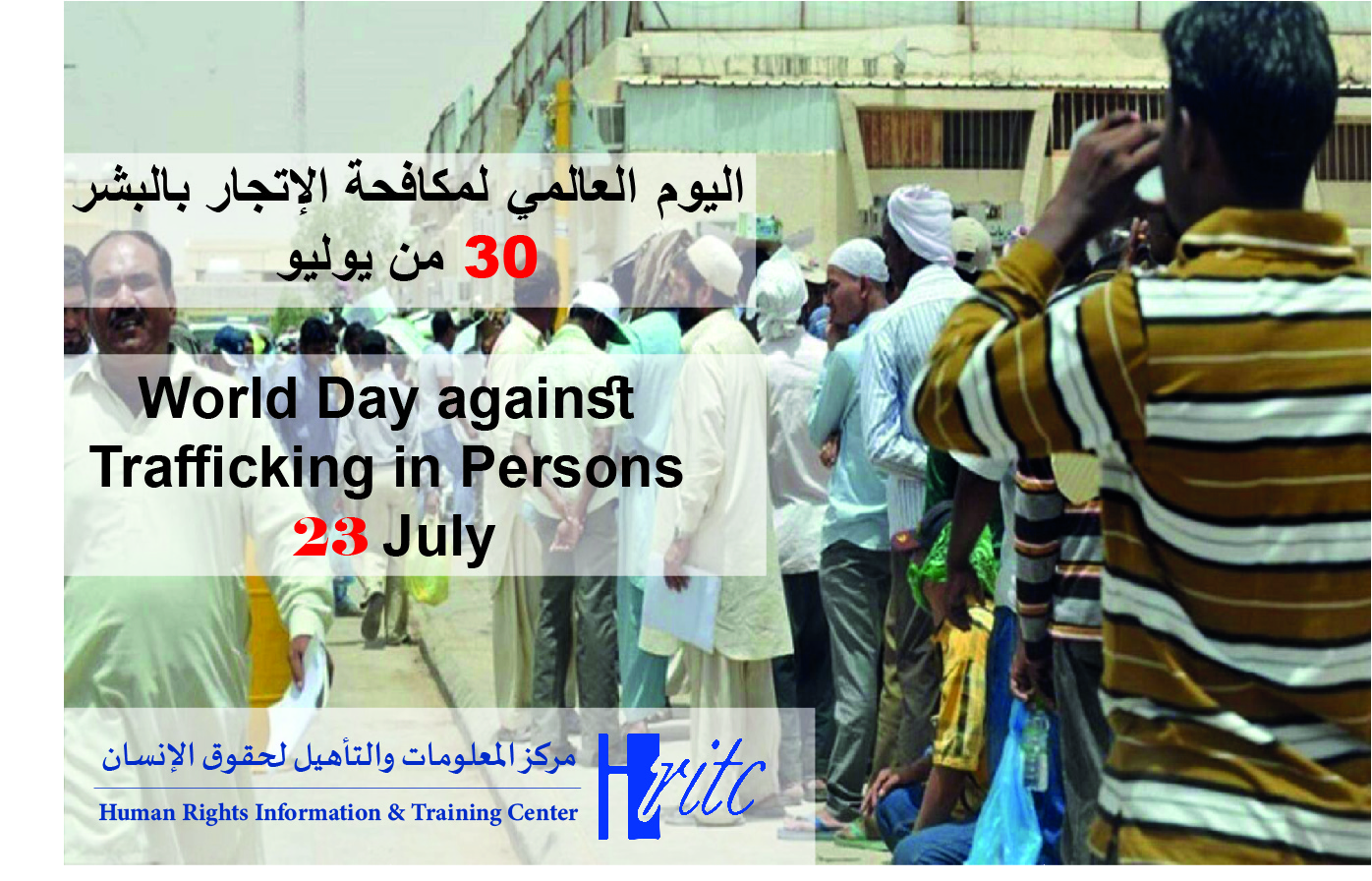
Human Rights Information and Training Center – HRITC called to reconsider the migrant labor laws in force in the Gulf states in a manner consistent with international laws and human rights values and principles. Which are based on safeguarding human dignity, noting in a statement today on the occasion of the World Day against Trafficking in Persons that falls on July 30.
(The sponsorship system or Kafala system) that exists in the countries of the Gulf Cooperation Council is still the greatest challenge to the rights of workers working in these countries and their migratory families.
The center said that these countries allow, through the procedures of the so-called right of the guarantor towards the migrant worker, to control the fate of the workers and their lives, prevent them from moving and choosing work according to the laws that transfer the powers of the state to the sponsor and private companies that bring in expatriate workers. Which makes the issue slip into a dangerous circle of grave violations Persistent up to the level of human trafficking and exposing the lives and dignity of migrant workers to grave violations.
This issue is a widespread phenomenon in the various countries of the Gulf Cooperation Council, where migrant workers constitute a huge percentage compared to the number of people in the Gulf countries.
According to the statistics circulated, approximately 17 million newcomers and their families live in it, topped by Saudi Arabia with nine million newcomers, followed by the United Arab Emirates.
The sponsor usually confiscates the migrant worker travel document. To subject him to his temper, compel him to act and intimidate him from leaving him without the sponsor being held accountable for that. The sponsorship system does not guarantee the worker the right to file a complaint in case of violating any of his rights, and the sponsor, in the event of filing a lawsuit against him by the worker, is able to register the absence or cancellation of the residence. Which enters the worker into the spiral of imprisonment and fines and confiscation of his money also deportation from the country due to the lack of the legitimacy of his stay without residency.
Even if the worker is given permission to remain until the complaint is decided, he is costly over the worker’s material energy.
According to the various international reports and numerous media statements that dealt with this file during the past period, the first beneficiaries of this procedure are the companies that trade in the residences of thousands of migrant workers from this system in large measure. After that come from the beneficiaries, some citizens who exploit this for their benefit in violation of labor rights, especially domestic. When cancelling residency and registering absenteeism, it is not taken into consideration whether or not domestic workers have obtained their financial rights, knowing that leaving a domestic worker to work is called a “flight” and is registered in the police station as a case of absence to leave for work.
Domestic workers are the most affected by the ‘kafala law’; Labor laws that are being amended to improve conditions for workers in the Arab Gulf states include many workers, except for domestic workers.
HRITC statement, a regional organization with consultative status with the United Nations, said that despite practical steps taken by some countries such as Qatar, Kuwait, and Saudi Arabia to amend laws, other countries have not yet worked on any legal amendment, although this remains insufficient and needs to be done. A fundamental and fundamental step that abolishes the sponsor’s mandate and returns the matter to the state and activates a just law that allows residence and freedom to work and to obtain basic rights to health, education, and movement for migrant workers and their families.
These are minimum rules that are recognized in today’s world. As for keeping laws that allow controlling the fate of people by others, it is a violation of human rights and the consecration of obsolete concepts of slavery.
Taiz, July 30, 2020
Human Rights Information and Training Center – HRITC