6:58 PM - 6 March, 2026
  • HOME
  • About HRITC
    • HRITC “PDF”
    • Who We Are?
    • general objective
    • Vision
    • Main Programs Of Center
    • Advisory Board and Organizational Structure
    • Annual activity reports
  • Reports
    • Qualitative Reports
    • Monthly monitoring reports
      • Monitoring reports 2025
      • Monitoring reports 2024
      • Monitoring reports 2023
      • Monitoring reports 2022
      • Monitoring reports 2021
      • Monitoring reports 2020
      • Monitoring reports 2019
      • Monitoring reports 2018
      • Monitoring reports 2017
      • Monitoring reports 2016
      • Monitoring reports 2015
    • Infographic Monitoring Of Violations
  • Follow-ups
    • Hritc News
    • General news
    • Press releases
    • Writings of the head of the center
  • Human Rights Library
    • Human rights issues
    • Educational and training materials
    • Documentation for United Nations committees and bodies
    • Human rights documents and instruments
    • Yemeni documents
  • Publications
    • Our Rights Journal
    • Guides Series
  • More
    • Events and conferences
    • Humanitarian Stories
    • HRITC Archives
  • Watch with us
  • en English
  • ar العربية
HRITC
  • Login
  • HOME
  • About HRITC
    • HRITC “PDF”
    • Who We Are?
    • general objective
    • Vision
    • Main Programs Of Center
    • Advisory Board and Organizational Structure
    • Annual activity reports
  • Reports
    • Qualitative Reports
    • Monthly monitoring reports
      • Monitoring reports 2025
      • Monitoring reports 2024
      • Monitoring reports 2023
      • Monitoring reports 2022
      • Monitoring reports 2021
      • Monitoring reports 2020
      • Monitoring reports 2019
      • Monitoring reports 2018
      • Monitoring reports 2017
      • Monitoring reports 2016
      • Monitoring reports 2015
    • Infographic Monitoring Of Violations
  • Follow-ups
    • Hritc News
    • General news
    • Press releases
    • Writings of the head of the center
  • Human Rights Library
    • Human rights issues
    • Educational and training materials
    • Documentation for United Nations committees and bodies
    • Human rights documents and instruments
    • Yemeni documents
  • Publications
    • Our Rights Journal
    • Guides Series
  • More
    • Events and conferences
    • Humanitarian Stories
    • HRITC Archives
  • Watch with us
No Result
View All Result
  • HOME
  • About HRITC
    • HRITC “PDF”
    • Who We Are?
    • general objective
    • Vision
    • Main Programs Of Center
    • Advisory Board and Organizational Structure
    • Annual activity reports
  • Reports
    • Qualitative Reports
    • Monthly monitoring reports
      • Monitoring reports 2025
      • Monitoring reports 2024
      • Monitoring reports 2023
      • Monitoring reports 2022
      • Monitoring reports 2021
      • Monitoring reports 2020
      • Monitoring reports 2019
      • Monitoring reports 2018
      • Monitoring reports 2017
      • Monitoring reports 2016
      • Monitoring reports 2015
    • Infographic Monitoring Of Violations
  • Follow-ups
    • Hritc News
    • General news
    • Press releases
    • Writings of the head of the center
  • Human Rights Library
    • Human rights issues
    • Educational and training materials
    • Documentation for United Nations committees and bodies
    • Human rights documents and instruments
    • Yemeni documents
  • Publications
    • Our Rights Journal
    • Guides Series
  • More
    • Events and conferences
    • Humanitarian Stories
    • HRITC Archives
  • Watch with us
No Result
View All Result
HRITC | مركز المعلومات والتأهيل لحقوق الإنسان
No Result
View All Result
The United Nations: When journalists are targeted, entire societies pay the price

The United Nations: When journalists are targeted, entire societies pay the price

5:10 PM - 2 November, 2020
in Follow-ups, General news
A A
681
SHARES
1.4k
VIEWS
شارك عبر البريد الإلكتروني

The United Nations: When journalists are targeted, entire societies pay the price


The UN Secretary-General said that when journalists are targeted, entire societies pay the price, indicating that if we do not protect journalists, our ability to stay informed about what is going on around us and make evidence-based decisions is very limited.

This came in a message issued by Mr. António Guterres on the occasion of the International Day to End Impunity for Crimes Against Journalists.

And when journalists cannot do their work safely, the Secretary-General says in his letter, we are losing an important line of defense against the pandemic of misinformation and misinformation that has spread online.

On this year’s International Day, the world, including the media, faces a completely new challenge, which is COVID-19.

The Secretary-General stated that this pandemic brought new risks to journalists and media workers, at a time when the number of attacks on their physical integrity increased.

“There were no less than 21 attacks on journalists while covering the protests in the first half of 2020, which is equivalent to the number of attacks they were exposed to in the whole of 2017.”

According to the Secretary-General, additional restrictions were imposed on the work of journalists, including threats of prosecution, arrest, imprisonment, denial of access to information, failure to investigate crimes against them and failure to prosecute their perpetrators.

Practicing without fear or favoritism

Mr. Guterres pointed out that news and fact-based analysis depend on ensuring the protection and safety of journalists performing independent journalistic work, rooted in the basic principle that says: “Doing journalism without fear or favor.”

At a time when the world is fighting the Covid-19 pandemic, the United Nations Secretary-General renewed the call for a free press that can play its primary role in the areas of peace, justice, sustainable development and human rights.

Journalists pay the price for speaking out

For her part, Audrey Azoulay, Director-General of UNESCO, emphasized in her message, by the way, that revealing the truth is one of the most important functions of journalists, and it involves identifying, collecting and verifying facts, and then accurately conveying their meaning.

However, many journalists are paying the price for speaking out, as she put it.

This position places journalists in a unique and decisive position that enables them to reveal the truth in the face of authority. Truth and authority do not necessarily coincide in all cases.

Between 2010 and 2019, Ms. Azoulay reports that nearly 900 journalists have been killed in the course of their work, and more than 150 journalists have died in the past two years alone.
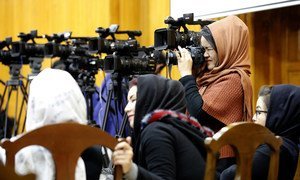
UNAMA / Fardin Waezi
Journalists during the celebration of the National Day of Afghan Journalists (March 2019), in support of media freedom and solidarity with journalists in Afghanistan.


Journalists in the crosshairs

Although many have died while covering conflicts, many more are being killed due to investigations into issues such as corruption, trafficking, political irregularities, human rights violations and environmental issues.

Death is not the only threat to journalists. An attack on the press, according to Ms. Azoulay, may include threats, kidnappings, arrests, imprisonment, and harassment – whether online or offline, targeting women in particular.

Protect freedom of expression

Although we may find some solace in the fact that the number of journalists killed in 2019 is the lowest in the past ten years, the Director-General of UNESCO said that attacks against journalists of all kinds are still continuing at an “alarming rate”.

The perpetrators of these crimes go unpunished in seven out of every eight murders of journalists.

And she stressed the need to make more efforts to stop this, noting that “the work of journalists is necessary to protect the basic right to freedom of expression, which is guaranteed by Article 19 of the Universal Declaration of Human Rights.”

In addition to the fact that journalists are subjected to assault and the perpetrators of the assault have evaded their actions, it means the collapse of the security and judicial system that benefit everyone.
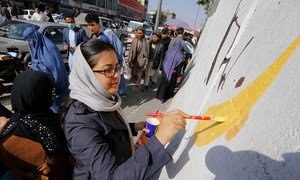
UNAMA / Fardin Waezi
A mural commemorating the two journalists killed in Afghanistan is painted on an explosion wall in central Kabul


End impunity

UNESCO celebrates this day annually on 2 November to raise awareness and highlight some of the specific risks journalists face in their quest to uncover the truth.

On the occasion of this day, the UNESCO Director-General called on all Member States and international and non-governmental organizations to unite efforts to ensure the safety of journalists and to eliminate impunity.

“Only by investigating the crimes committed against media professionals and prosecuting the perpetrators can we guarantee access to information and freedom of expression.”


Unleash the information

UNESCO also celebrated this day by issuing a report entitled “Protecting Journalists, Protecting Truth”. Among other things, the report revealed that most journalists have been killed in countries where there is no armed conflict.

While impunity for crimes against journalists continues to prevail, 13 percent of cases were reported resolved worldwide in 2020, compared to 12 percent in 2019 and 11 percent in 2018.

The results of the report also showed that Latin America and the Caribbean witnessed 40 percent of all recorded killings worldwide, in 2019, followed by the Asia-Pacific region, with 26 percent.

“States have a duty to protect journalists, and judges and prosecutors in particular play an important role in promoting the speedy and effective implementation of criminal proceedings, with the aim of ensuring that perpetrators of crimes against them are held accountable,” Ms. Azoulay emphasized.


Source: United Nations website
SendShare272Tweet170Share48Send

Related Posts

نحو 30 ألف حالة انتهاك موثق في تعز
- Breaking news

نحو 30 ألف حالة انتهاك موثق في تعز

1:36 AM - 4 February, 2026
1.4k
87 انتهاكا يوثقها مركز المعلومات خلال الربع الثاني للعام الجاري بتعز
Hritc News

87 انتهاكا يوثقها مركز المعلومات خلال الربع الثاني للعام الجاري بتعز

1:04 AM - 21 December, 2025
1.4k
Panel of Experts on Yemen: Crisis & Houthi Refusal of Dialogue
Follow-ups

Panel of Experts on Yemen: Crisis & Houthi Refusal of Dialogue

6:42 PM - 8 November, 2025
1.4k
Yemen Panel of Experts highlights on human rights violations in Yemen
- Cursor

Yemen Panel of Experts highlights on human rights violations in Yemen

6:29 PM - 8 November, 2025
1.4k
UN Summit in Doha to Revitalize the Social Contract
Follow-ups

UN Summit in Doha to Revitalize the Social Contract

5:26 PM - 31 October, 2025
1.4k
عدامات واغتصاب جماعي خلال توغل قوات الدعم السريع في الفاشر
Follow-ups

Executions and mass rapes: During the Rapid Support Forces’ incursion into Al-Fashir

5:07 PM - 31 October, 2025
1.4k
Load More

Center Archive

Facebook Twitter Youtube Instagram RSS

Obtaining consultative status in the United Nations Economic and Social Council
Obtaining observer status with the League of Arab States

Newsletter

    The Republic of Yemen – Taiz – Al-Majliyah Tel: 04-216277
    Coordination offices for the center in Aden – Cairo – Beirut

    © 2025 Human Rights Information and Training Center | HRITC All rights reserved .. Development by Target-group.org

    Welcome Back!

    Login to your account below

    Forgotten Password?

    Retrieve your password

    Please enter your username or email address to reset your password.

    Log In
    No Result
    View All Result
    • HOME
    • About HRITC
      • HRITC “PDF”
      • Who We Are?
      • general objective
      • Vision
      • Main Programs Of Center
      • Advisory Board and Organizational Structure
      • Annual activity reports
    • Reports
      • Qualitative Reports
      • Monthly monitoring reports
        • Monitoring reports 2025
        • Monitoring reports 2024
        • Monitoring reports 2023
        • Monitoring reports 2022
        • Monitoring reports 2021
        • Monitoring reports 2020
        • Monitoring reports 2019
        • Monitoring reports 2018
        • Monitoring reports 2017
        • Monitoring reports 2016
        • Monitoring reports 2015
      • Infographic Monitoring Of Violations
    • Follow-ups
      • Hritc News
      • General news
      • Press releases
      • Writings of the head of the center
    • Human Rights Library
      • Human rights issues
      • Educational and training materials
      • Documentation for United Nations committees and bodies
      • Human rights documents and instruments
      • Yemeni documents
    • Publications
      • Our Rights Journal
      • Guides Series
    • More
      • Events and conferences
      • Humanitarian Stories
      • HRITC Archives
    • Watch with us
    • Login
    • en English
    • ar العربية
    مركز المعلومات والتأهيل لحقوق الإنسان يستخدم ملف تعريف الارتباط Cookieإعرف أكثر.
    • العربية
    • English