The European Court of Human Rights (ECHR) has ruled it is not a crime to deny mass killings of Armenians by Ottoman Turkey in 1915 was a “genocide” on Thursday.
Earlier this year, Amal Clooney, the human rights lawyer, took on the controversial case and was part of a team representing Armenia in a case in which a Turkish politician was convicted by Switzerland for denying the genocide in 1915 ever took place.
How did the Armenian genocide end up in the ECHR?
Doğu Perinçek, chairman of the Turkish Workers’ Party, described the genocide of up to 1.5 million Armenians – a fact Turkey disputes as well as the number of those killed – as an “international lie” in Switzerland in 2005.
A lobby group called Switzerland-Armenia immediately filed a criminal complaint against him in July as it is against Swiss law to deny the genocide as part of the country’s anti-racism laws.
Mr Perinçek was found guilty of racial discrimination in 2007 in Switzerland because “his motives were of a racist tendency”, according to a later description of the case in an ECHR press release in 2013.
The Turkish national exhausted legal routes in Switzerland to appeal the judgment but his appeal was dismissed and in June 2008, he lodged an application to the ECHR complaining that his freedom of expression was breached.
The Turkish government also submitted written comments as a third party questioning the veracity of the genocide.
In December 2013, the ECHR agreed with Mr Perinçek and said his conviction was “unjustified”.
Why was Amal Clooney representing Armenia?
Armenia challenged the ECHR’s verdict and was represented in the case by lawyers from Doughty Street Chambers in London.
For many Armenians, the genocide, like the Holocaust of six million Jews, is still a painful issue exacerbated by Turkey’s continued denials. In the Perinçek case, Armenia hoped to set out that the genocide is a fact which cannot be denied without legal repercussions.
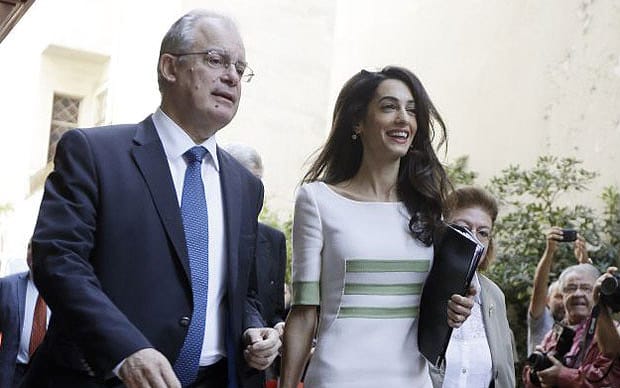
 Amal Clooney with Kostas Tassoulas, Greek culture minister, during her last high profile case – the return of the Elgin Marbles Photo: Thanassis Stavrakis/AP
What happened in 1915?
In the last years of the Ottoman Empire, ethnic divisions became a bigger problem for those in charge and the Armenians were viewed with suspicion.
Turkish historian, Taner Akçam, in his book, A Shameful Act, explained how non-Muslim communities were organised in a millet system of limited self-government. Although the Ottomans ruled, certain groups along religious and ethnic lines had limited control over their own affairs.
In 1908, junior army officers – referred to as the Young Turks and Committee of Unity and Progress (CUP) – seized power from Sultan Abdul Hamid II, and the country underwent a process of what many historians call “Turkification”. This nationalism was intended to bring all cultures together but in 1914, “the Young Turks began a campaign to portray the Armenians as a kind of fifth column,” according to John Kifner in the New York Times.
It is generally accepted by many, including historians such as Ara Sarafian, an Armenian historian, that the start of the massacres was April 24, 1915. This was the date on which several hundred Armenian individuals were arrested and killed and led to further massacres across Turkey.
The map below shows the areas where massacres took place – the larger the circle, the greater the number of those killed.
It is believed this lasted until 1917 and led to 1.5 million Armenians killed – a figure Turkey disputes, putting the figure at 300,000 to 600,000. Armenians are said to have sided with the Russians, and there were groups who did so – the southeastern city of Van was seized at one point in 1915.
 Armenia says up to 1.5 million of its people were killed during World War I by forces belonging to Turkey’s former Ottoman Empire
The murders took the form of death marches and deportations of Armenian families. Many died as a result of hunger and exhaustion but many were killed and their bodies found in mass graves years later.
In 1923 – the same year the republic was established – similar events occurred but “with less intensity”, according to Raffi Sarkissian, co-chairman of the Armenian Genocide Centenary Commemoration Committee.
The Armenian National Institute, a Washington DC-based organisation, said the deportations were disguised as a resettlement programme.
“The brutal treatment of the deportees, most of whom were made to walk to their destinations, made it apparent that the deportations were mainly intended as death marches. Moreover, the policy of deportation surgically removed the Armenians from the rest of society and disposed of great masses of people with little or no destruction of property.”
The events were not unknown to either the media – New York Times’ archive of coverage – or governments. In 1915, the actions were described as a “crime against humanity” by France, Britain and Russia.
But if there is evidence, why does Turkey deny it was a genocide?
Turkey’s position – explained by Geoffrey Robertson QC, founder of the Doughty Street Chambers in his book, An Inconvenient Genocide – is that the intent to kill Armenians was not genocidal, according to its meaning.
Raphael Lemkin, a lawyer of Polish-Jewish origin, coined the term genocide as “referring to violent crimes committed against groups with the intent to destroy the existence of the group”.
The Turkish republic does not deny there were deaths but disputes the 1.5 million figure and that the intent was to eliminate an entire race. Turkey claims the killings were part of a conflict not a systematic genocidal campaign of murder and “that the Armenians as a group took up arms against their own government” and joined Russian forces.
Turkey said “demographic studies prove that prior to World War I, fewer than 1.5 million Armenians lived in the entire Ottoman Empire. Thus, allegations that more than 1.5 million Armenians from eastern Anatolia died must be false”.
But Mr Robertson points out the Armenian Church estimates 2.1 million Armenians lived in the empire.
According to Mr Sarafian, there are papers which indicate the genocidal nature of Turkey’s actions including the papers of Talaat Pasha, one of the Young Turks in charge of the Ottoman Empire, published by a Turkish journalist in 2011.
Mr Sarafian told Mediamax: “I decided to present his data as the official view of the Armenian Genocide according to Ottoman records… It has a column showing the Armenian population of different provinces in 1914 according to official Ottoman statistics, and it has a column that has been generated from the returns to the 1917 survey. Most of these missing Armenians were probably killed.”
What does the Turkish foreign ministry say?
The Telegraph contacted the Turkish foreign ministry for comment on both the ECHR case and the Armenian genocide claims.
According to Turkey, “our memory does not support the Armenian narrative on the events of 1915, [but] it is only Turks and Armenians who can effectively address their issues together and work jointly to find ways forward. Turkey is ready to do its part”.
 Recep Tayyip Erdo?an, the Turkish president Photo: AFP
Recep Tayyip Erdoğan, the Turkish president, has also acknowledged the “suffering [of] Turkish, Kurdish, Arab, Armenian and millions of other Ottoman citizens”.
The ministry’s full explanation of Turkey’s position can be found here.
Orhan Tung, press counsellor at the Turkish embassy in London at the time it was published, wrote in the New Statesman in 2007, “credible evidence” had not been shared to prove it was a genocide – an argument Turkey often repeats.
“On the legal aspect, the elements of the genocide crime are strictly defined and codified by the UN Convention on the Prevention and Punishment of the Genocide, adopted by the General Assembly on 9 December 1948. However, Armenians, claiming that “the evidence is so overwhelming”, so far have failed to submit even one credible evidence of genocide.”
Where does the debate currently stand?
In total, 18 countries accept the massacres as genocide, including Germany, Greece, and France (you can find the full list here).
The British parliament does not officially refer to the killings as genocide, but John Whittingdale, a Conservative MP and British-Armenian All-Party Parliamentary Group, told The Telegraph it was a “terrible massacre [that] we should recognise as genocide”.
Mr Whittingdale added he thought it was “unlikely” the British government would accept the 1915 events as genocide.
Mr Sarafian told the Telegraph he is however hopeful Turkey will recognise the events as a genocide.The historian who frequently goes to Turkey said although it still “hurt for the state to deny the events”, Mr Erdoğan has made Turkey more open to discussion – despite his denials.
“In the 1980s I studied in Turkey and with my friends – they knew I was Armenian – we never discussed the genocide.”
Now the historian goes to south-eastern Turkey for events that explore the genocide and he hopes to encourage both sides to talk about it “because we are the same”.